
Modern vehicles are more than just machines: they’re a showcase of advanced chemistry in action.
Every part, from the sleek exterior panels to the complex electronics under the bonnet, relies on carefully engineered chemical processes. Without them, we wouldn’t have the durable, efficient, and high-performance cars we depend on today.
From the polymers shaping dashboards and seats to the electroplating that protects metal components, chemistry is at the core of automotive manufacturing.

Even fuel, lubricants, and safety features like airbags are a direct result of chemical innovation.
The question is, then, what chemicals are actually used across the industry, and how?
In this post:
Key Takeaways
Chemistry drives automotive manufacturing, shaping materials, coatings, fuel, and safety features
Key processes like polymerisation, electroplating, and redox reactions enhance durability, efficiency, and performance
Many automotive chemicals can be hazardous, but automation and safety measures help reduce risks
Common chemicals include polypropylene (PP), polyurethane (PU), ABS, polyamide, PBT, sodium azide (NaN₃), and ethylene glycol
How is Chemistry Used in the Automotive Industry?
The automotive industry uses chemistry throughout the entire production process, in several different ways:
- Prefabrication of materials and components – this includes the production of fibreglass panels, plastic dashboards, and seating upholstery
- Treatment of components – this includes electroplating the chassis and painting the panels
- Providing electrical energy – the source of potential electrical energy, a car battery is an assembly of galvanic cells that relies on oxidation-reduction reactions
- Fuelling the engine – whether it’s a diesel, gasoline, electric, or a fuel cell engine, the power source of every vehicle can ultimately be traced back to chemical reactions
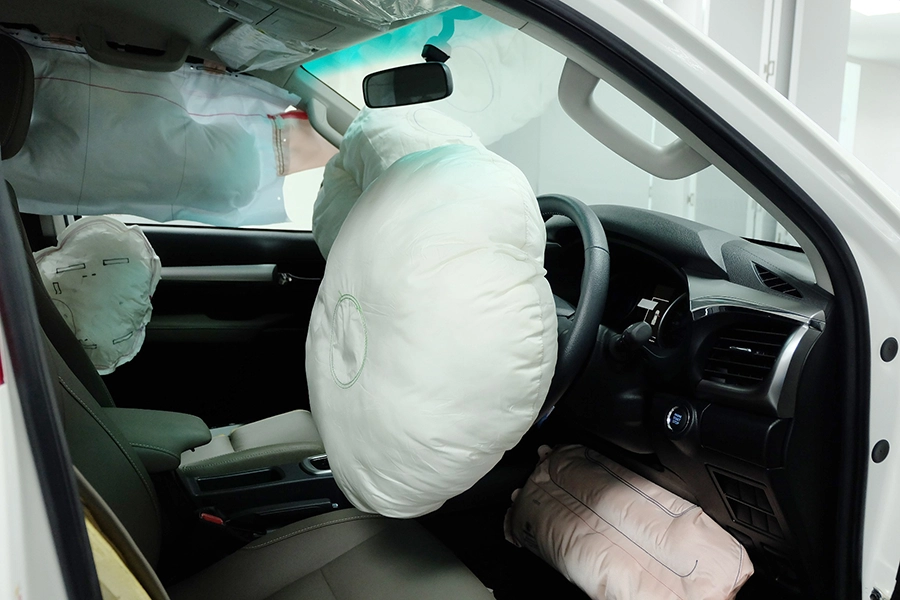
- Providing safety features – airbags, for example, rely on chemical reactions that rapidly release nitrogen during a head-on collision
Are Commonly Used Chemicals in the Automotive Industry Harmful?
Many of the chemicals used in the automotive industry, such as paint, coolant, hydraulic fluids, lubricants, and fuel additives are potentially harmful to humans, although not all to the same extent.
While modern automation has reduced direct contact with these substances, risks remain in certain tasks:
- Paint and coatings – Automotive paints contain volatile organic compounds (VOCs), which can cause respiratory issues with prolonged exposure. However, robotic painting systems now handle much of the process.
- Coolants and hydraulic fluids – Ethylene glycol, commonly found in engine coolants, is toxic if ingested and requires careful handling during maintenance.
- Lubricants and fuel additives – Some petroleum-based products contain benzene and other carcinogenic substances, requiring safety precautions when handling.
While the end user is unlikely to encounter too much harm from general car usage, those involved with its upkeep and creation need to take precautions.
Regulatory bodies such as the Health and Safety Executive (HSE) provide guidelines to minimise occupational hazards in the automotive sector.

The Top Five Chemicals Used in the Automotive Industry
The chemicals used in the automotive industry mainly exist in prefabricated forms, such as the polyurethane foam that’s used to upholster the seats. Other chemicals, like paint, are added later during the finishing process.
While there are countless chemicals used across the industry, here’s a breakdown of the top five most common:
1. Polypropylene
Polypropylene (PP) is a thermoplastic polymer with various applications in the automotive industry. It’s commonly used in car bumpers, wheel covers, cable insulation, and carpet fibres due to its durability and resistance to heat and chemicals.
Polypropylene is made by polymerising propylene monomers using heat, which categorises it as a thermoplastic addition polymer. Like many plastic materials, its raw components are derived from petroleum.
The polymerisation process for polypropylene was first developed in 1951 by Paul Hogan and Robert Banks, two scientists working for the Phillips company.
Applications of Polypropylene
- Bumpers and wheel covers for impact resistance and reduced weight
- Cable insulation to protect wiring from heat and wear
- Carpet fibres for durability and ease of maintenance
- Battery cases and trays due to its chemical resistance
- Fuel system components, including tanks and pipes, for corrosion resistance
2. Polyurethane
Polyurethane (PUR or PU) is a versatile polymer commonly used in car interiors, particularly for seat padding. It’s formed by organic units linked together by carbamate, producing a wide range of structures that serve different automotive applications.
Unlike other polymers, polyurethane can be synthesised from various materials, resulting in different forms such as rigid and flexible foams, varnishes, coatings, adhesives, and electrical potting compounds.
This adaptability makes it one of the most widely used materials in vehicle manufacturing.
Applications of Polyurethane
- Seat cushioning for comfort and durability
- Soundproofing materials to reduce noise inside the cabin
- Varnishes and protective coatings for scratch and UV resistance
- Adhesives used in bonding interior and exterior components
- Thermal insulation in certain vehicle parts

3. Acrylonitrile Butadiene Styrene
Acrylonitrile butadiene styrene (ABS) is a type of thermoplastic polymer with the generic chemical formula (C8H8)x·(C4H6)y·(C3H3N)z. It has an amorphous, or non-crystalline, structure, making it difficult to pinpoint its true melting point, though it does undergo a glass transition temperature of 105 °C.
Applications of Acrylonitrile Butadiene Styrene
- Instrument panels and dashboards for their durability and impact resistance
- Interior trim components for aesthetic appeal and lightweight properties
- Door handles and panels due to their high structural integrity
- Grilles and exterior trims for their weather resistance
- Moulded parts that require precision and toughness
4. Polyamide
Polyamide, known to most of us as nylon, is a synthetic polymer used extensively in the automotive industry. While natural polyamides such as wool and silk exist, synthetic variants are manufactured for industrial use and are better at accepting chemical coatings.
Polyamide’s high mechanical strength, heat resistance, and flexibility make it ideal for various vehicle components.
Applications of Polyamide
- Engine covers and air intake manifolds due to their heat resistance
- Fuel lines and connectors for chemical resistance and durability
- Gears and bearings to reduce friction and enhance performance
- Electrical connectors and wiring harnesses for insulation properties
- Under-the-hood components requiring high mechanical strength

5. Polybutylene Terephthalate
Polybutylene terephthalate (PBT) is a high-performance thermoplastic polyester that mainly serves as an insulator in electrical and electronic parts. It’s used in the automotive industry to insulate a vehicle’s electronic components, especially high-voltage parts like the ignition system, though it has other applications as well.
Applications of Polybutylene Terephthalate
- Insulation for high-voltage electronic components, including ignition systems
- Windshield wiper covers for durability and weather resistance
- Mirror housings for impact resistance and lightweight properties
- Cowl vents and sensor housings for heat and chemical resistance
- Fuse boxes and connectors for electrical safety
Conclusion
There are countless chemicals used across the automotive industry, from the construction of the vehicles themselves to the final decorative touches and the after market care and maintenance involved. Understanding the role each of these elements play makes it easier to appreciate the showcase of chemistry that modern cars truly are.