Both manufacturing and contract manufacturing services focus on the mass production of certain products or components. The main difference is that contract manufacturers are hired by other companies to produce items on their behalf.
Manufacturers can either produce finished products intended for the end user/customer, or they can make components that are used to manufacture other products. For example, aerospace parts such as the fuselage and the interior finishings aren’t made directly for end users, but for aeroplane manufacturers.
Some businesses contract other companies to make components or manufacture entire finished products on their behalf. Known as contract manufacturing companies, these firms are essentially subcontractors for other businesses. Read on to learn more about manufacturing and contract manufacturing services.
For more detail, read our comprehensive guide to contract manufacturing.
In this post:
What is manufacturing?
Manufacturing refers to the mass production of any product or item that has commercial and industrial value. The intended customer can either be the general public or other businesses.
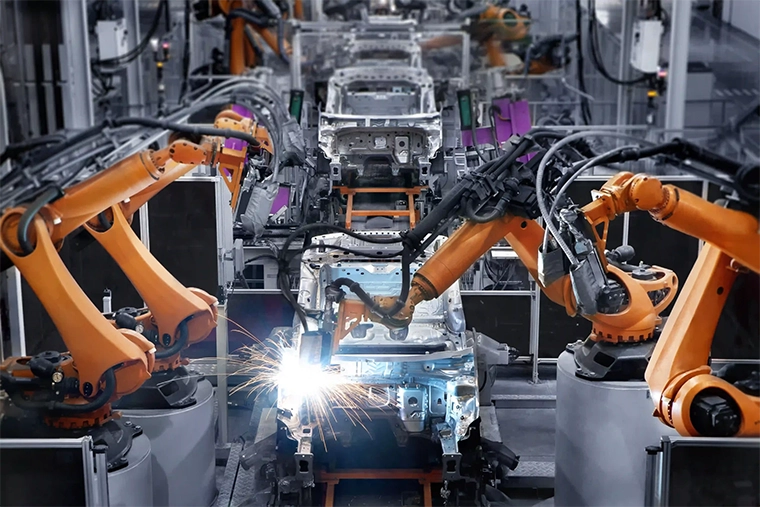
Industrial-scale manufacturing typically involves automated, high-speed multistage processes that require minimal human intervention. People generally play a supervisory role, overseeing machine operation, quality assurance, and system maintenance. Examples of industrial-scale manufacturing include car manufacturing, electronic gadgets manufacturing, and canned food manufacturing.
Cottage-scale manufacturing, however, is much more labour intensive. Although machines may still be used, they’re not designed to produce products in a rapid or automated manner. Examples of small-scale manufacturing include making items such as home-cooked jams, wooden furniture, crochet sweaters, and personalised gift items.
Manufacturing processes can be classified into the following five categories:
- Repetitive manufacturing – this involves a dedicated production line that manufactures the same or similar products for sustained periods. Machines are often left to run 24 hours a day, seven days a week (depending on the demand), although the speed may vary on a seasonal basis. Thanks to its repetitive nature, this type of manufacturing involves minimal changeover or setup.
- Discrete manufacturing – this also uses assembly lines, but the products or components being manufactured tend to be more diverse. There’s usually a variety of setups and changeovers are very common.
- Job shop manufacturing – a more labour-intensive process, job shop manufacturing doesn’t tend to use production lines, but rather has production areas. Products are made in small batches and may be customised to suit the end user.
- Continuous process manufacturing – although similar to repetitive manufacturing, process manufacturing involves different states of raw materials such as gases, powders, and slurries.
- Batch process manufacturing – this is similar to both the discrete and shop types of manufacturing processes, but the products tend to be more diverse.
What is contract manufacturing?
Contract manufacturing is where a third-party company manufactures products under the brand name of another business. In other words, it’s an outsourced manufacturing service.
Many well-known businesses outsource some of their manufacturing needs to other companies, either locally or internationally, in an effort to cut costs. Using an external company allows them to reduce their overhead expenses because they don’t incur the expenses associated with maintaining a factory.
Some companies also choose to contract external manufacturers because they don’t have the expertise or the right facilities. Instead, they enlist the services of other companies that have more experience and the equipment necessary to produce certain specialised products, for example, bespoke chemical formulations. Another example might be a fast-food chain that hires a contract manufacturer to produce its in-store toy merchandise.

Manufacturing vs. contract manufacturing
Contract manufacturing is a subset of manufacturing. Start-up companies often contract out their manufacturing because they don’t typically have the technical expertise and facilities to manufacture their own products in-house. During the early stages at least, many businesses choose to concentrate on product design, marketing, sales, and research and development.
That being said, there are also large companies and well-known brands that contract out one or more aspects of their production. The main reason for this is usually to maintain low overheads and increase profitability. It also explains why many big companies choose to outsource the manufacturing of their branded products to countries with low labour costs and cheap raw materials.
Why use a manufacturing service?
Manufacturing services not only include the production of goods but also quality control, quality assurance, stability testing, packaging, and other related services. A business can choose to exclusively hire another company for their manufacturing services, which works in a similar way to leasing. The latter still maintains its autonomy but only serves one client.

Using an external manufacturing service can save start-up businesses valuable time and money because it means they don’t have to set up their own factory.
Why use a contract manufacturing service?
If you only need small batches or require highly-customised products or chemical repacking services, it often makes sense to choose a contract manufacturing service. For a start, it’s significantly cheaper and more flexible. Contract manufacturing typically also allows you to produce products in a shorter time frame.
Which service is right for your business?
The first and most important consideration when choosing a contract manufacturing service is the company’s ability to meet your needs. Does it have the right expertise and experience? Does it have sufficient logistics capacity? What’s the turnaround time and are there any stipulations regarding quantity?
Your budget and target outputs will also determine which type of manufacturing service is most suitable for your business. If you’re looking for long-term mass production, a manufacturing service is usually the best option. On the other hand, if you want a more flexible short-term service, contract manufacturing may be the most sensible route.
Summary
Manufacturing refers to the mass production of products or components that have commercial value. A subset of manufacturing, contract manufacturing is when a business outsources aspects of its manufacturing to another company that’s more equipped to handle it.
Whether it’s better to use a manufacturing service or a contract manufacturing service depends on your needs and budget.
With almost 50 years’ experience, we’re one of the UK’s leading chemical manufacturers and contract manufacturing organisations. So if you’re looking to outsource your chemical manufacturing or contract packing requirements, contact us to discuss how we can help you.