At ReAgent, we have a wide range of mixing and storage tanks to support our chemical blending, packing, and water purification services.
All of our mixing vessels have conical bases, designed to maximise yield and enable efficient cleaning between product changes.
Here’s a look at five of our biggest tanks, showing the scale and capability of our operations.
In this post:
1. 22,500L Stainless Steel Mixing Vessel
This is our largest tank, designed for blending products up to 5,000cps in viscosity. A 5kW motor drives a stainless steel mixing impeller, supported by internal baffles that improve efficiency.
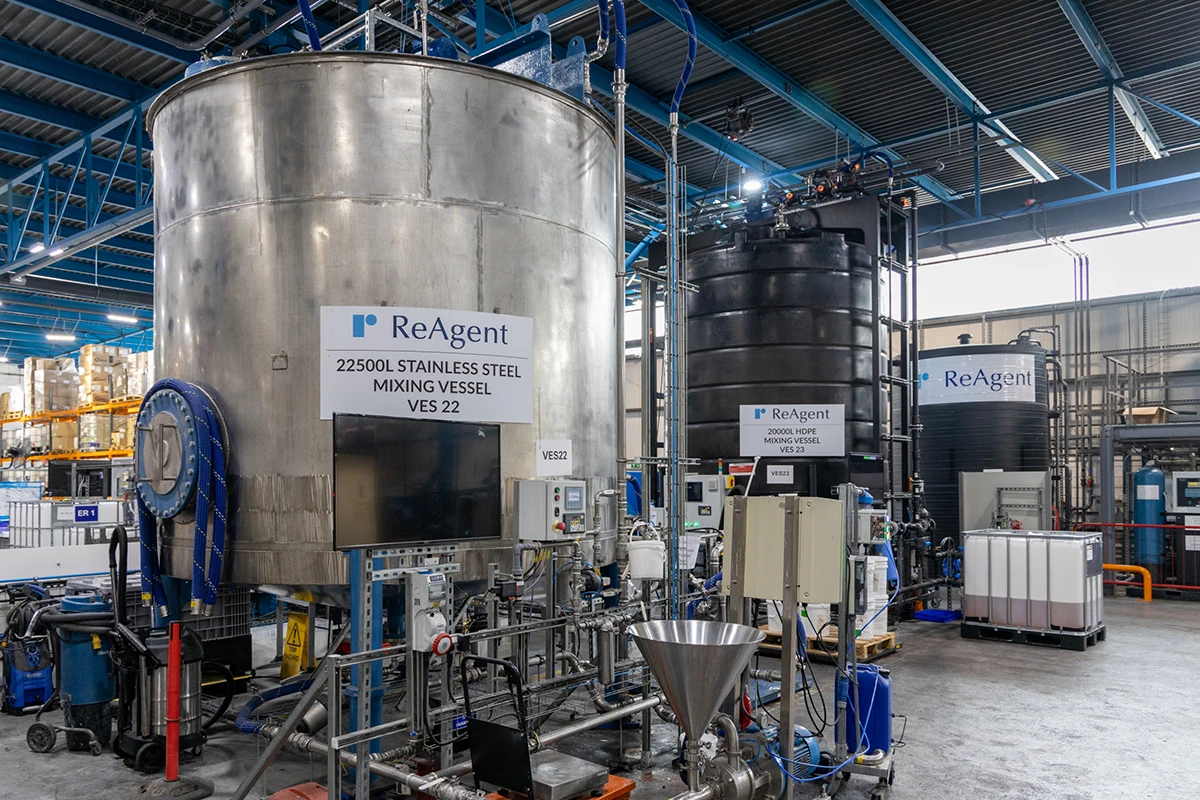
Recirculation pipework features an inline static mixer for a consistent, homogenous product.
Made from 316 grade stainless steel, this vessel is compatible with a wide range of products, aside from acidic blends.
An electronically driven diaphragm pump ensures effective recirculation and packing, while in-line filtration down to 0.2 micron maintains product quality.
2. 20,000L HDPE Mixing Vessel
Built for blending products under 40°C, our 20,000L HDPE mixing tank handles anything except solvents.
A 2.2kW motor powers an ebonite-coated shaft, protecting contact parts when working with corrosive materials. It’s ideal for blending low-viscosity products below 30cps.
The vessel includes an inline static mixer, electronically driven diaphragm pump, and 0.2 micron filtration. All contact parts are corrosion-resistant, making this tank highly versatile.

3. 20,000L Stainless Steel Deionised Water Tank
Our 20,000L water tank provides bulk storage for our deionised water supply (see the image in section 5).
Made of 316 stainless steel, it’s designed for quick access and high-capacity use. The water passes continuously through UV and mesh filtration to ensure quality and to prevent bacterial growth.
We can fill 25,000L road tankers in under two hours, and the vessel is automatically refilled by our water systems, ensuring a consistent supply for all pack sizes.
4. 16,000L HDPE Raw Water Storage Tank
Our raw water tank holds feedstock for our deionised water and purification plants.

With a supply delivering over 10,000L per hour, this vessel ensures we maintain a steady reserve to protect against fluctuations and keep production running smoothly.
5. 15,000L Stainless Steel Mixing Vessel
Like our 20,000L stainless steel vessel, this 316 stainless steel vessel is suitable for a wide range of products, aside from acidic blends.
A 4.5kW motor powers the impeller, supported by diaphragm pump recirculation and 0.2 micron in-line filtration.
Like our other blending tanks, it can pack into IBCs using automatic dosing systems or through automated packing equipment, including our latest packing line.

Partner With Us For Your Chemical Blending Needs
At ReAgent, our tanks give us the flexibility to handle a huge variety of chemical blending, storage, and packing projects.
Whether it’s high-volume water storage or specialist mixing, our equipment ensures efficiency, consistency, and quality.
Contact our friendly team today to learn how we can support your chemical requirements.