About the author

Jessica Clifton

Executive Director

Jessica is Executive Director at ReAgent and leads a variety of growth projects. She has an extensive background in marketing, and has worked in the chemical industry since 2019. Outside of work, Jessica can be found on a run, building LEGO, or watching Star Wars.
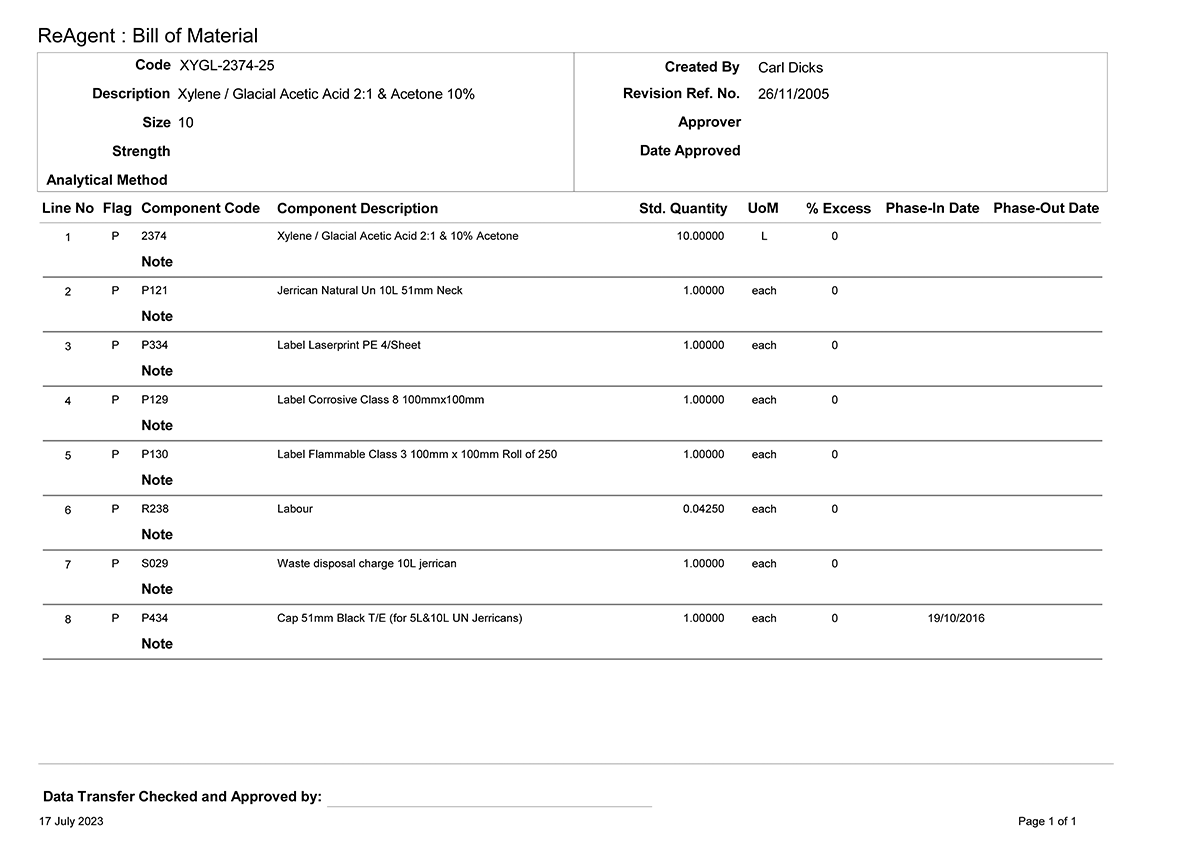
Example of a bill of materials (BOM) from ReAgent Chemicals

What Is A Bill Of Materials?

A bill of materials (also known as a BOM) is a comprehensive document that contains a list of the materials that are needed to manufacture a product.  It also includes step-by-step instructions on how to make and assemble that item.

A ReAgent chemist analysing samples in the lab

How Outsourcing to a Contract Packing Company Will Benefit Your Business

Whether you have a well-established company or you’re just starting up, outsourcing to a contract packing company has many advantages.  As well as freeing up time and reducing your operational overheads, it allows your business to benefit from industry-specific expertise

ReAgent's break out room with ReAgent logo

A Company Milestone: ReAgent Is Now Trademarked

As a well-established, high-growth company with almost 50 years in business, we recently decided to trademark both the ReAgent logo and the company name ReAgent. Protecting our intellectual assets from imitation means that other companies aren’t able to use similar

Mission statement display

WATCH: Wall Art Installation

ReAgent has been making extensive aesthetic improvements to our offices, which has included installing new wall art across our offices, kitchen, and canteen. The aim of doing this has been to create a more comfortable work environment for our team,

Two people shaking hands

What Does A Contract Manufacturing Agreement Look Like?

A contract manufacturing agreement is a legal document that defines the commercial relationship between a client (an individual or a business) and a manufacturing company. Just like other contracts, it stipulates the obligations of both parties and the terms of

Person holding a pair of safety glasses next to a blue jerrycan of hazardous chemicals

Labelling Chemical Solutions

The labels on chemical containers are designed to ensure the substance is used safely and correctly. Whether in the laboratory, home, or an industrial setting, these labels must contain essential details about the chemical including its name, formula, and hazard

Scientist holding an Eppendorf tube with a sample as part of a DNA extraction procedure.

Maintaining pH Balance In Biological Systems

Just like other biological systems, the human body relies on biological buffers to maintain the ideal pH balance. Without them, we wouldn’t be able to maintain homeostasis or perform vital biological functions. Our blood, for instance, requires a pH range

chemical hazards on test tubes

A Guide To Preparing & Handling Chemical Solutions

Preparing and handling chemical solutions can be very dangerous, especially if you’re dealing with corrosive, toxic, flammable, or explosive substances. However, the following measures can minimise the risk and help to keep everyone safe: Provide hazard communication training Provide safety